
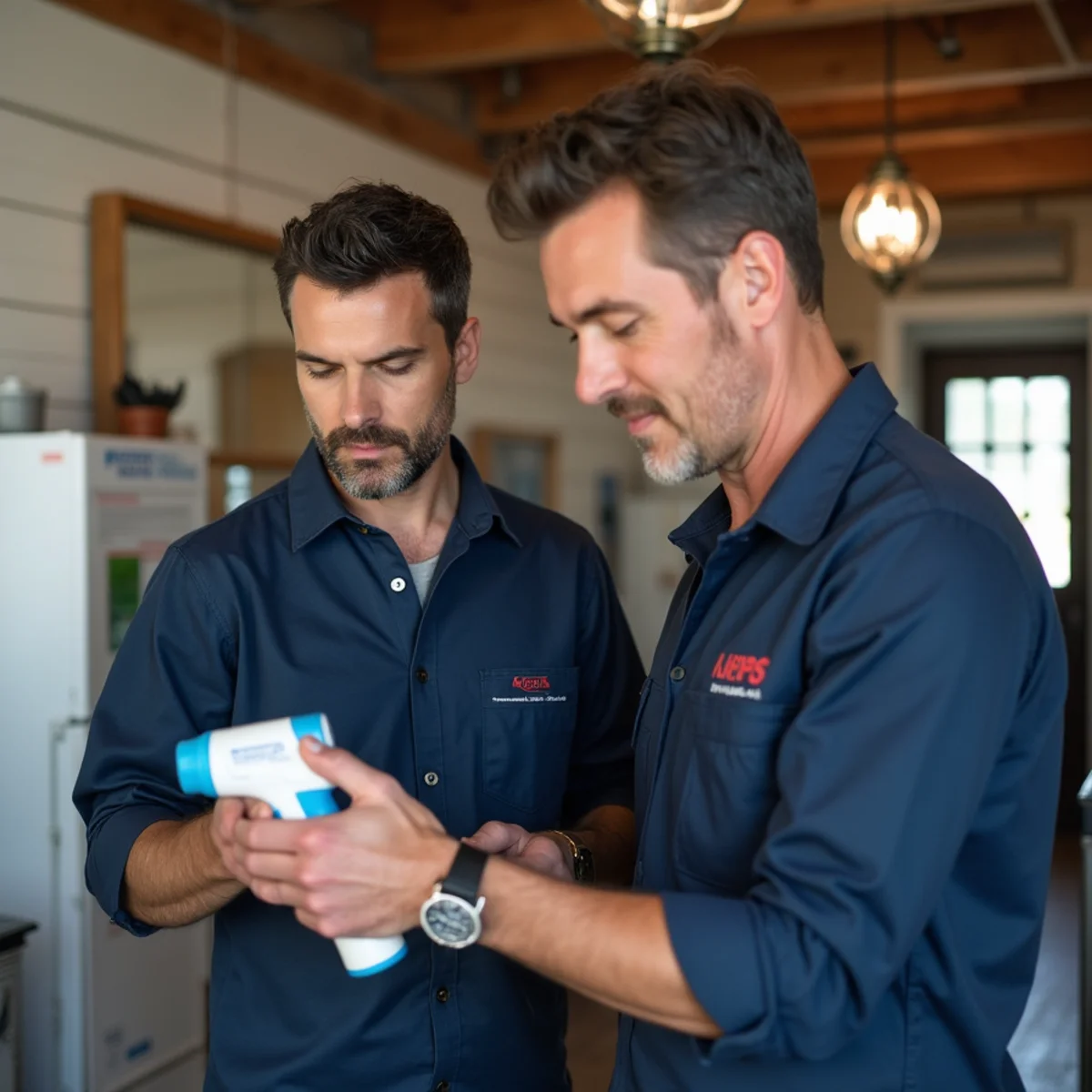
'It's running, but it's not cooling' might be the most common sentence in our July call log — and it's actually several different problems wearing the same words. After enough summers in Frankfort attics and crawlspaces, the diagnosis order becomes instinct. Here it is, in plain English, in the same sequence our techs work it.
Some of these you can fix in ten minutes. Others are the compressor's way of asking for help. Knowing which is which is the whole game.
1. Airflow Starvation: The Filter and the Freeze
Start where every tech starts: the filter. A clogged filter chokes airflow until the evaporator coil drops below freezing and ices over — an iced coil can't absorb heat, so the system runs faithfully while cooling nothing. Check the filter, then look at the copper line set: if it's frosted, you've found the chain of events.
Turn the system off (fan ON to thaw), swap the filter, and give it a couple of hours. If it cools normally afterward, you're done. If it iced with a clean filter, the cause is deeper — restricted ducts, a failing blower, or low refrigerant — and that's a service call with specifics to share.
2. The Outdoor Unit's Bad Day
The condenser has to dump indoor heat outside, and July in Frankfort makes that job brutal. A coil matted with cottonwood fluff, grass, or the season's pollen film can't reject heat efficiently, and high head pressures throttle capacity until the system 'runs but can't keep up.' Kill the power at the disconnect and gently rinse the coil with a garden hose — never a pressure washer.
Also look at the fan: spinning? A dead condenser fan with a humming compressor is an emergency shut-off situation — that heat needs somewhere to go, and the compressor becomes the victim. Same with a unit that hums and does nothing else: that's frequently the capacitor, the most common single failure of Kentucky summers.
Need this handled by a pro today?Same-day service across Franklin County • 24/7 emergency dispatch
Call +1 (327) 210-59993. Low Refrigerant: The Leak That Pretends
If the system 'needed a recharge' last summer and seems low again, it doesn't use refrigerant — it loses it. Slow leaks show up as long runtimes, a shrinking temperature split, and ice on the coil or line. Fast leaks hiss audibly and can empty a system in days.
A tech with gauges and an electronic leak detector finds it, shows you where it is, and gives you the fix-versus-replace math honestly. What they should never do is top it off and wish you luck — that's a subscription plan, not a repair.
4. The House Is Winning: Load and Duct Issues
Sometimes the AC is fine and the house is the problem: attic duct runs leaking cooled air into 130° spaces, undersized returns choking circulation, sun-loaded west rooms fighting physics, or a thermostat on a wall that reads hot all afternoon. These complaints cluster in older Frankfort housing — the 60s–70s ranches of East Frankfort are classic cases.
Static-pressure testing and register measurements find these without touching the equipment, which is why we bring instruments before we bring opinions. Duct sealing and return corrections have 'saved' many systems that were one bad quote away from replacement.
5. When It's Actually an Emergency
Call immediately — and shut the system down first — for: breakers that trip repeatedly, grinding or metal-on-metal sounds, burning smells from vents or the unit, a compressor that hums without the fan, or a system that iced and won't cool after thawing. Those symptoms escalate fast, and the difference between a $150 visit and a $2,500 compressor is usually measured in hours of continuing to run.
Everything else — lukewarm air, slow cooling, one warm room — can wait for a scheduled visit without damage, though not without discomfort. Call +1 (327) 210-5999 and tell us which list you're on; we'll tell you what to do while you wait.
- Check filter → thaw if iced → clean outdoor coil
- Fan not spinning or unit humming dead: shut off, call
- Annual 'recharge' needs = leak; fix it, don't feed it
- Older home, some rooms warm? Measure ducts before replacing anything
- Tripping breaker, burning smell, grinding: shut off now
The Bottom Line
'Running but not cooling' is several problems wearing the same words — filter, coil, charge, or ducts. Work the checks in order, shut down for the danger signs, and let measurements settle the rest. Our techs diagnose with instruments, show you the failed part, and fix the cause rather than the symptom.
Frequently Asked Questions
In July, the top three are: dirty condenser coil, low refrigerant from a slow leak, or duct/return airflow problems — often in that order for newer systems, reversed for older Frankfort housing. Temperature-split and static readings separate them in one visit.
Yes — refrigerant carries oil and cools the compressor. Running low doesn't just cool poorly; it actively starves the most expensive component in the system. 'It still runs' is not 'it's fine.'
Classic signs: the outdoor unit hums but the fan doesn't start (or starts with a push — don't do this), or the system clicks and tries to start without success. A tech confirms with a microfarad reading in seconds. It's the most common July repair in Frankfort and it's same-visit on our trucks.