
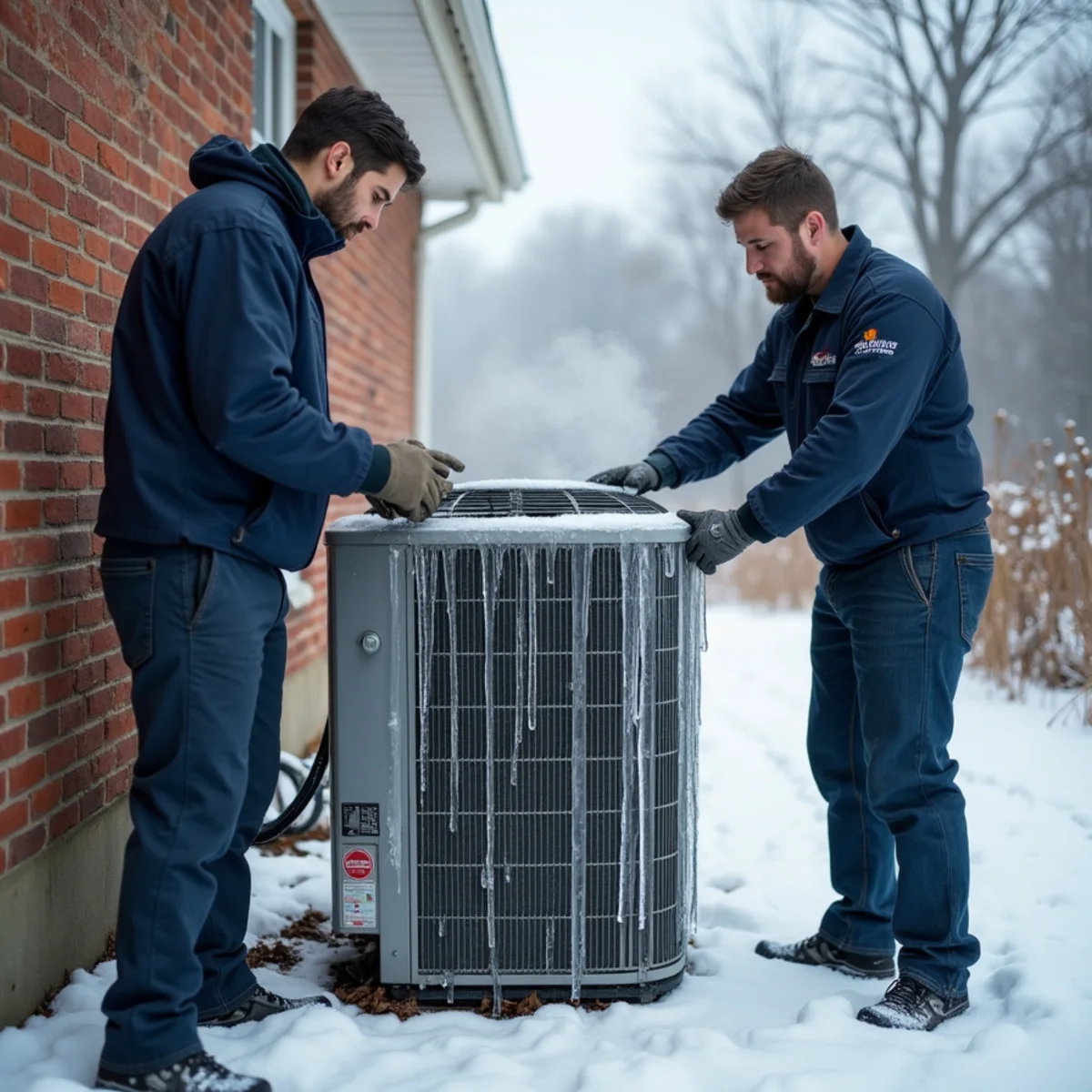
The morning after an ice storm, Frankfort's heat pumps tell three different stories. Some steam gently and run fine — normal defrost. Some sit under a rime of ice but keep heating — also survivable. And some are frozen solid, silent, or locked out while AUX heat burns money and the house slowly cools. Knowing which story yours is telling saves compressors, money, and cold nights.
This is the distinction our Bald Knob and ridgeline customers learn by necessity — wind-exposed units ice up first and worst — and it applies to every heat pump in Franklin County after freezing rain.
Normal Defrost: The Steam Show
In freezing, damp weather, frost builds on the outdoor coil and the unit runs defrost cycles — reversing into a brief cooling mode to melt it. You'll see steam or fog rising off the unit, maybe hear the reversing valve thunk, and notice the supply air runs cool for five to ten minutes. That's the machine working correctly, usually every 30–90 minutes in bad weather.
Nothing needs doing. Don't switch to EM heat for defrost cycling alone; you'll just pay double for heat the heat pump was making efficiently.
Warning Signs: Ice That Never Leaves
The trouble starts when ice accumulates faster than defrost clears it, or when defrost stops running at all. Warning signs: ice building unit-wide including the cabinet top, the fan unable to spin, defrost cycles running 20+ minutes without clearing anything, water pooling and refreezing around the base pad, or the unit tripping its breaker.
Those symptoms usually mean a failed defrost board or sensor, a stuck reversing valve, low refrigerant, or a unit that's low on airflow — all repairs, and all worse the longer the system runs iced. Ice on a running unit also blocks airflow, which strains the compressor into the bargain.
- Ice building unit-wide, including the cabinet top — not just frost on the coil.
- Fan unable to spin or grinding against ice.
- Defrost cycles running 20+ minutes without clearing anything.
- Water pooling and refreezing around the base pad.
- The unit tripping its breaker — leave it off and call.
Need this handled by a pro today?Same-day service across Franklin County • 24/7 emergency dispatch
Call +1 (327) 210-5999The First Hour: What to Do (and Not Do)
Do switch the thermostat to EM (emergency) heat if your system has it — strip heat costs more but takes over heating entirely and lets the outdoor unit rest. Do switch the system fully off if it's tripping breakers or making grinding sounds. Do call us — a frozen-solid unit with a failed defrost cycle needs professional thawing and diagnosis.
Don't chip, pry, or pour hot water on the ice. Chipped coil fins and burst refrigerant joints turn a sensor repair into a replacement. Don't keep resetting breakers; a compressor fighting a fan full of ice is a compressor being destroyed. And don't cover the unit with anything — heat pumps need airflow even in deep winter.
Why Ridgetop and Exposed Units Suffer Most
Wind-driven freezing rain coats everything it touches, and ridgeline homes — Bald Knob, the high ground north of town — take the brunt. Exposure also drives heavier defrost demand, which is why we spec exposed installations with wind-aware placement and keep defrost components in top shape through fall maintenance.
If your unit ices badly every storm, that pattern is diagnostic in itself: repeated heavy icing points to defrost components, refrigerant charge, or placement issues that a maintenance visit can usually correct before the next event.
After the Thaw: The Follow-Up That Matters
Once a unit survives an icing event, it deserves a check: defrost sensor readings, board function, refrigerant pressures, and coil condition after the ice. Ice events bend fins, work fittings loose, and find the weak components. A post-storm inspection is cheap insurance against the next storm finding the same weakness.
If your heat pump locked out and AUX heat carried you through, note how long and how cold — that history helps us set your balance point and staging correctly for the rest of the winter.
The Bottom Line
Defrost steam is a heat pump working; solid ice is a heat pump asking for help. Knowing the difference protects the compressor, the budget, and the household's comfort. When in doubt, switch to emergency heat and call — frozen-unit diagnoses are among our fastest winter repairs when they're caught early.
Frequently Asked Questions
Light frost with active defrost is normal operation. A unit iced solid with the fan blocked should be rested on EM heat — running a blocked compressor strains and can destroy it.
Let ambient thawing do the work with the system off or on EM heat — it may take hours in a hard freeze. Professional thawing plus diagnosis is the safe route when the unit must be restored quickly. Never chip or pour hot water.
Kentucky winters are icing weather, but every-storm failures point to a correctable cause: defrost board or sensor health, refrigerant charge, airflow, or placement. A maintenance visit usually identifies it.