
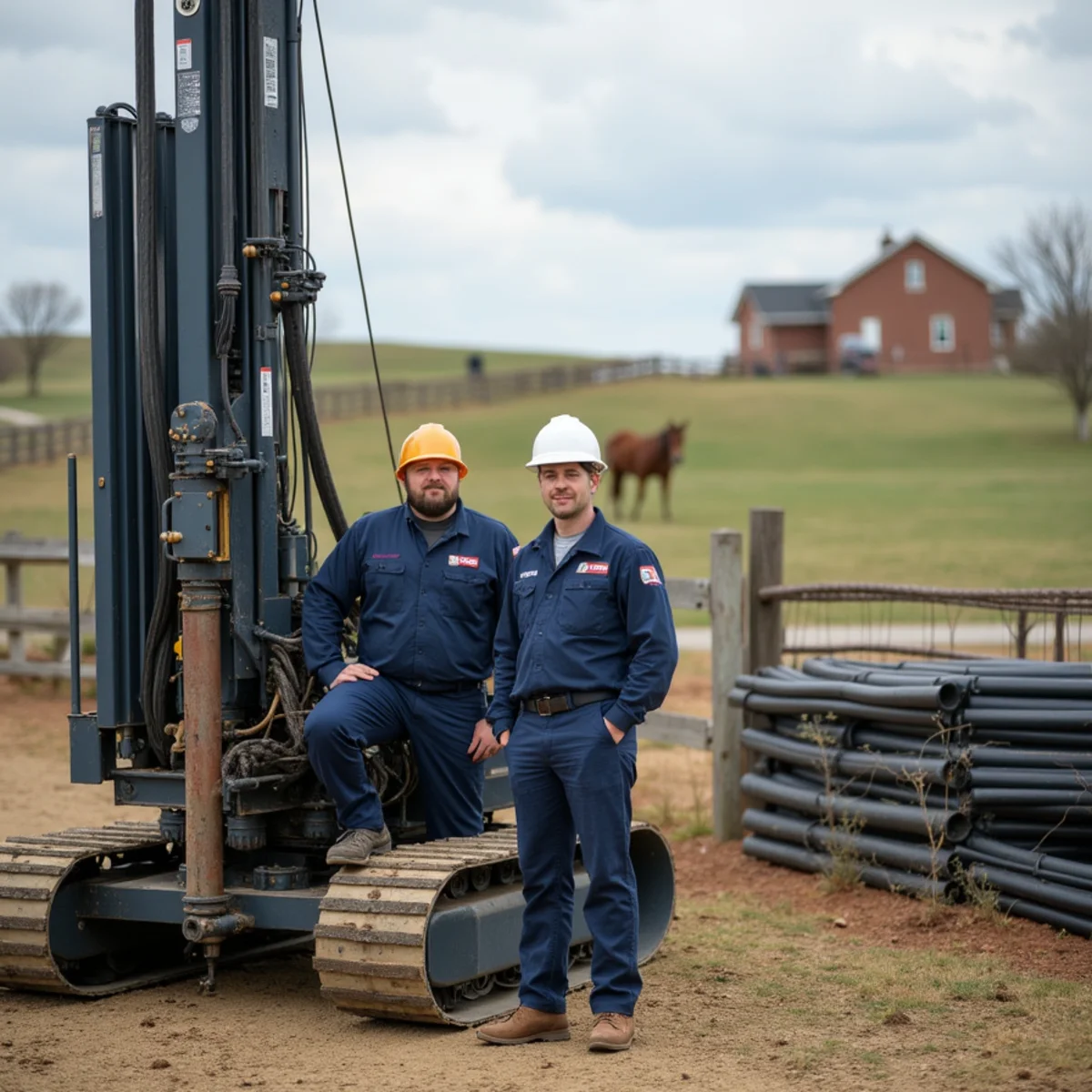
Kentucky's Inner Bluegrass may be the best underused geothermal region in America: steady-temperature limestone aquifers, spacious properties, and a four-season load profile that ground-source systems eat for breakfast. Yet drive Versailles to Frankfort and you'll pass hundreds of outdoor condensers for every loop field. The reason is usually the same: nobody ever showed the homeowner the honest math.
Here it is — the real cost structure, the real savings, and the honest payback conversation for horse-country and Frankfort-area properties.
Why the Ground Beats the Air Here
Air-source heat pumps fight whatever the weather is doing — 88° July afternoons and 15° January mornings. Ground-source systems exchange heat with soil that holds a steady mid-50s temperature year-round, which is why geothermal delivers heating and cooling at efficiencies air-source can't touch: typically 40–60% lower heating and cooling bills, with the biggest wins over electric strip heat and propane.
Kentucky's geology helps: Bluegrass limestone drills predictably and our shallow groundwater improves loop performance. The result is systems that quietly produce decades of comfort with no outdoor unit to ice up, flood, or hail-damage.
What Drives the Cost
The loop field is the headline: horizontal loops in open yard are the least expensive, vertical bores cost more per ton but fit smaller lots, and pond loops can be economical where a suitable pond exists — no shortage of those in horse country. Drilling conditions in the Bluegrass are favorable; equipment access is usually the bigger constraint than rock.
The indoor side mirrors conventional replacement: heat pump capacity, air handler, duct condition, and zoning. Estate properties add multi-zone design — which is also where geothermal's savings scale up, because big homes burn the most energy.
- Loop type: horizontal loops in open yard are least expensive; vertical bores cost more per ton but fit smaller lots; pond loops shine where a suitable pond exists.
- Drilling logistics — Bluegrass limestone drills predictably here; equipment access is usually the bigger constraint.
- Home size and zoning: estate loads scale equipment and loop tonnage, and also scale the savings.
- Existing ductwork condition, and whether the project includes zoning controls.
- Incentives: federal geothermal tax credits and utility programs materially change payback — we bring current options to the quote.
Need this handled by a pro today?Same-day service across Franklin County • 24/7 emergency dispatch
Call +1 (327) 210-5999The Payback Math, Honestly
Typical payback runs 5–12 years depending on what the system displaces: all-electric strip heat sees the fastest returns, older propane sees strong ones, and high-efficiency gas sees slower ones. After payback, the system keeps producing savings for decades — indoor units commonly serve 20–25 years and loop fields are rated 50+.
The honest caveats: short-horizon owners capture less of the value, homes with excellent existing equipment capture less than homes running antiques, and the investment is front-loaded. Federal geothermal tax credits and any available utility incentives materially improve the math, and financing spreads the front-load. We model all of it against your actual bills before anyone signs anything.
Where Geothermal Fits Best Around Frankfort
Estate properties in Versailles and Midway horse country: acreage for loops, multi-zone loads, owners who plan in decades. Large-lot homes in Indian Hills and the county's edges: enough yard for horizontal loops without drilling. New construction anywhere: geothermal installed during building is dramatically cheaper than retrofitting, and Two Creeks-style developments are natural candidates.
River-adjacent and storm-exposed properties deserve a mention too: no outdoor condenser means no flood damage, no ice-storm crush, no hail bill — a resilience dividend that's hard to price until you've replaced a drowned unit once.
How to Find Out If It's Worth It for Your Property
Start with a feasibility visit: we review your lot, geology context, current bills, and ductwork, then model loop options and projected savings with your real usage numbers. The output is a side-by-side — conventional replacement versus geothermal — with costs, incentives, and payback for each. Then you decide with data.
Call +1 (327) 210-5999 to schedule the review. Worst case, you learn geothermal isn't your best move and you've spent nothing. Best case, you're the first house on your road with no outdoor unit and a heating bill that makes neighbors curious.
The Bottom Line
Kentucky's Bluegrass is underused geothermal country, and the math only works when it's modeled honestly — your bills, your lot, your loads. The feasibility visit costs nothing and ends either way with data. If your property fits, you could be the first house on the road with no outdoor unit and a bill that makes neighbors curious.
Frequently Asked Questions
Vertical bores disturb small footprints that are restored and reseeded; horizontal trenching affects more ground but recovers within a season. We walk the site plan with you before any ground opens — paddocks, driveways, and mature trees get routed around.
Most residential projects run a few days to two weeks depending on loop type and site logistics — drilling days plus the indoor changeover. New-construction integration is the fastest path.
Estate-scale lots with drilling access and multi-zone loads are the ideal case, and Woodford County has plenty. The feasibility model with your actual bills answers it definitively — that's the free first step.