
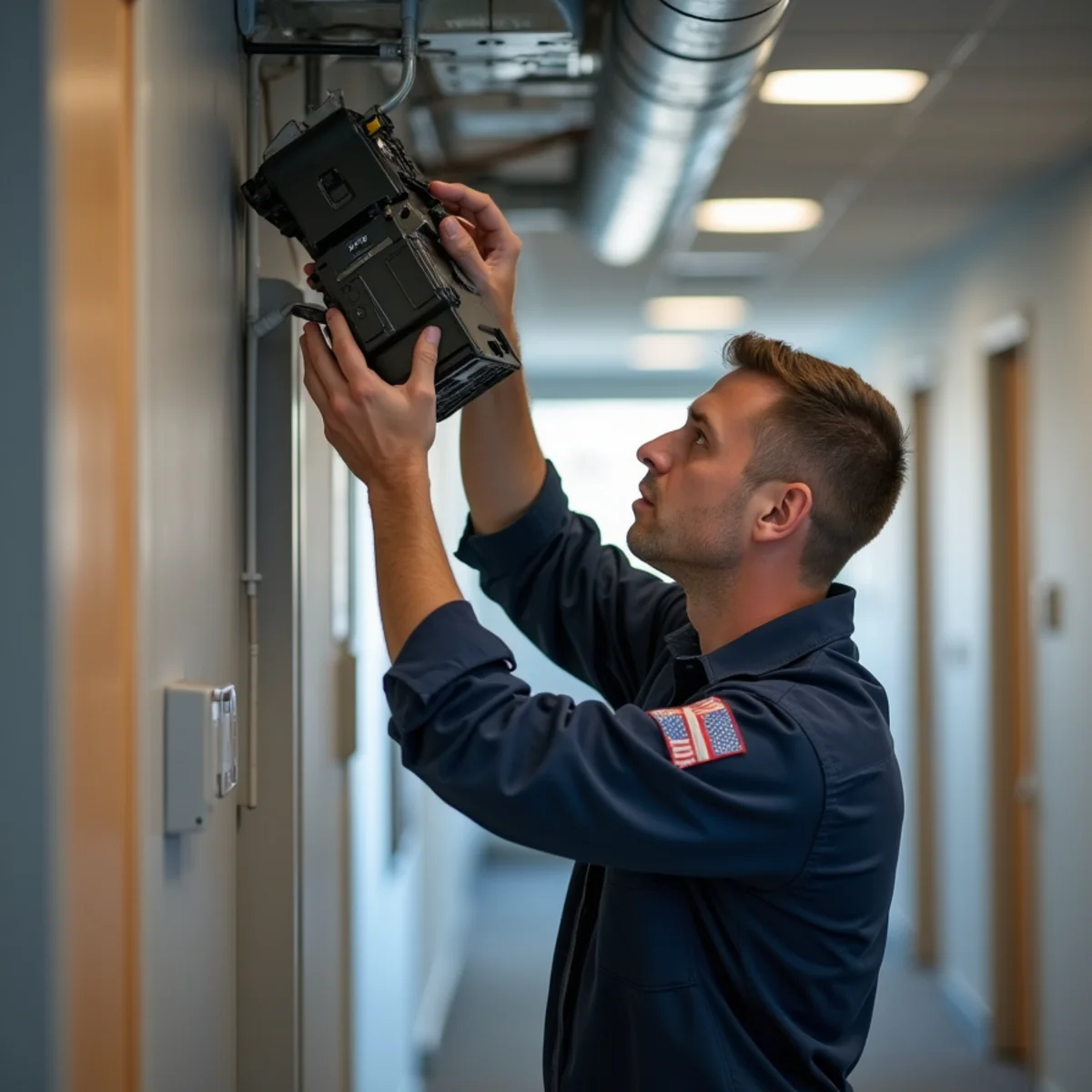
Frankfort hosts something no other Kentucky city does: a full state government campus, with the Capitol complex, Capitol View Park-adjacent offices, and a workforce of thousands whose comfort complaints route through facility managers whose jobs depend on answers. Government-occupancy HVAC is its own discipline — compliance paperwork, documentation standards, and comfort that holds through committee-season meeting loads.
We serve that world. Here's what HVAC for the capital's office market actually requires.
The Documentation Standard
Government and institutional buildings need vendors who clear paperwork as reliably as they clear condensate drains: current licenses and insurance with certificates that arrive without chasing, W-9s on file, itemized invoicing that survives audits, and condition documentation in writing after every visit. This isn't overhead — for facility managers, it's the job.
Our commercial operation is built for it: licensed, insured, documented, and responsive to the procurement realities of public-adjacent work. The same standard applies to the private offices, banks, and practices around the complex.
- Current licenses and insurance with certificates that arrive without chasing.
- W-9s on file and itemized invoicing that survives audits.
- Condition documentation in writing after every visit — the facility manager's paper trail.
- Model and serial records for every piece of equipment, so future diagnoses start informed.
The 8-to-5 Comfort Problem
Office buildings have a unique load shape: empty nights, morning ramp-ups, afternoon sun loads on Capitol-facing exposures, and conference-room spikes that no residential system ever sees. Comfort complaints in offices cluster where zoning fails — the south-facing corner office at 82° while the interior library sits at 68°.
Solving it is a controls-and-zoning discipline: damper operation verified, sensors placed where people are (not where the original drawings guessed), and schedules matched to actual occupancy. We've corrected enough zone maps to know the drawings lie more often than the thermostats do.
Need this handled by a pro today?Same-day service across Franklin County • 24/7 emergency dispatch
Call +1 (327) 210-5999RTUs and the Rooftop Reality
Frankfort's office stock runs heavily on packaged rooftop units — economical, serviceable, and utterly dependent on maintenance. RTU failure modes are predictable: economizers stuck open in July, belts and bearings aging quietly, control boards vulnerable to the power anomalies our storm seasons produce. A quarterly PM visit catches essentially all of them early.
Replacement economics matter at this scale too: staged phasing across multiple units, crane coordination, and after-hours changeouts that never interrupt business hours. We plan RTU projects around the workday, because the workday is the point.
The Capitol-Adjacency Micro-Market
The neighborhoods and businesses around the Capitol complex — Capital View, the downtown edge, the state-adjacent corridors — form Frankfort's densest concentration of office-adjacent service demand: private practices, law offices, government-adjacent vendors, and the mixed-use buildings that serve them all.
Proximity matters here: our shop's location puts the Capitol area among our fastest commercial response zones, and our crews already run the district daily for residential and light-commercial work. For facility managers, that's the difference between 'scheduled' and 'handled.'
Setting Up Institutional Service
Start with a building assessment: equipment inventory with model/serial records, rooftop survey, zone-by-zone comfort review, and a maintenance calendar matched to your fiscal year. Contracts include priority response, documented PM reports, and the COI paperwork your procurement office actually asks for.
Call +1 (327) 210-5999 to schedule the assessment. Frankfort's state buildings keep the capital running; keeping their air right is our end of the partnership.
The Bottom Line
Government-adjacent comfort is a documentation business with an HVAC side: COIs on file, written condition reports, zone maps that match reality, and response that respects the workday. Frankfort's state buildings keep the capital running; keeping their air right is our end of the partnership. The building assessment starts the file.
Frequently Asked Questions
Yes — licensed and insured with the documentation, certificates, and vendor paperwork government facilities require. Much of our commercial practice exists precisely for that standard.
Yes — after-hours and weekend service windows at quoted rates, plus phased project scheduling that keeps buildings operational throughout. Office-hour protection is built into how we plan commercial work.
Usually, yes — zone damper operation, sensor placement, and airflow balancing correct most office unevenness without equipment replacement. We diagnose with measurements first; controls corrections follow the data.