
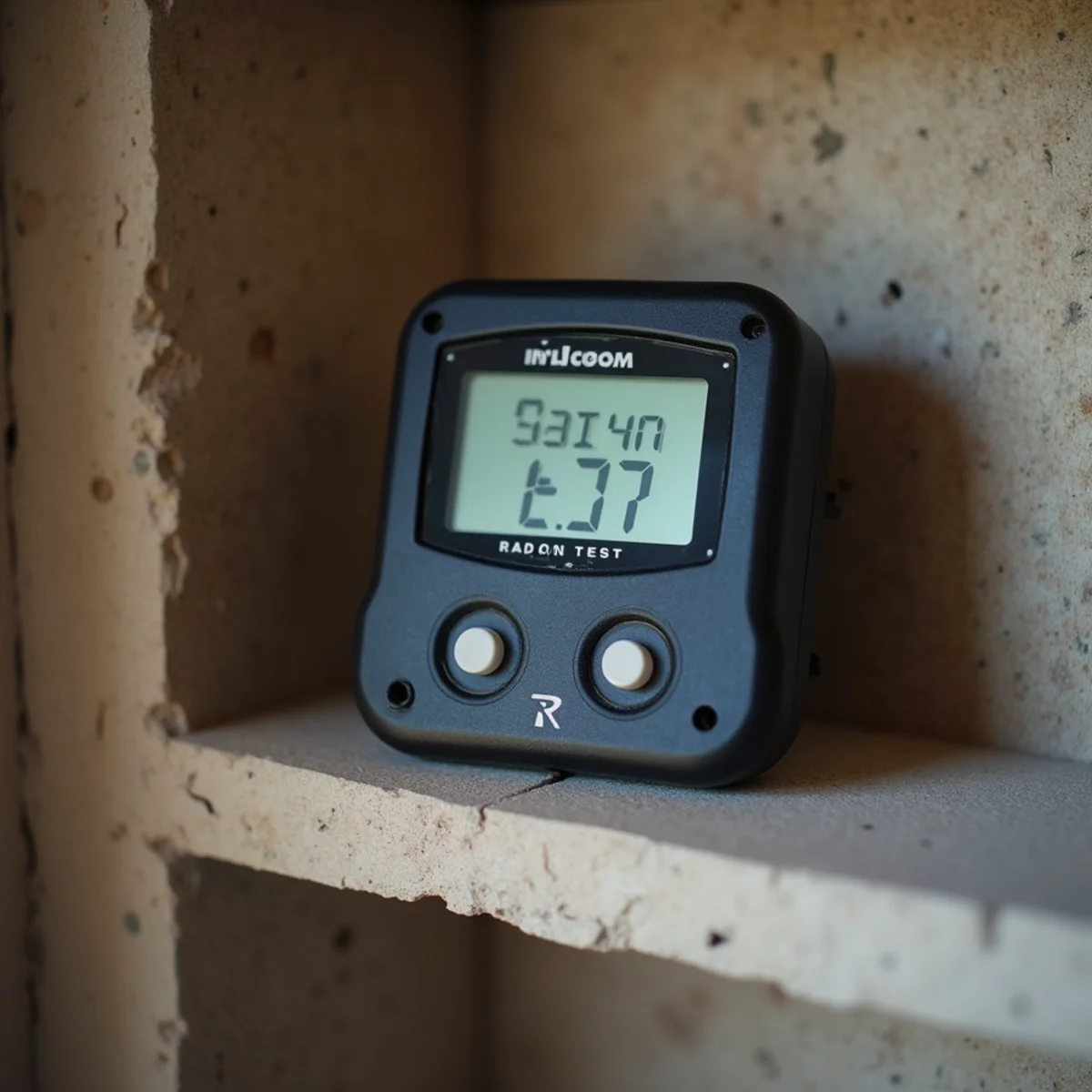
If you've never thought about radon, here's the number that should start the thought: roughly 7.8 pCi/L — Franklin County's published average indoor radon level, nearly double the EPA's 4.0 action threshold and comfortably into the range health agencies call high-risk. Radon is the leading cause of lung cancer among non-smokers, and it's in the ground under much of Frankfort.
The number sounds alarming. The response to it, satisfyingly, is not: a test kit and a plan. Here's what the average means, what your house's actual number might be, and what fixes what.
Understanding the Number
Radon is measured in picocuries per liter (pCi/L) — a measure of radioactivity in air. The EPA's action level is 4.0; levels above 2.0 are worth addressing. Franklin County's ~7.8 average means the typical local home tests in the range where mitigation is clearly justified — and averages hide spread: some homes test at 2, some at 15. Geology, construction, and foundation details swing results house to house.
Radon comes from uranium decaying in soil and rock — Bluegrass limestone and shale carry their share — and it concentrates wherever houses meet the ground: basements, crawlspaces, slab foundations. It's odorless, colorless, and only a test kit can see it.
Test First: The Only Meaningful Number Is Yours
County averages predict nothing about your basement. Short-term test kits (2–7 days, hardware stores and online, inexpensive) give the fast answer; long-term kits (90+ days) give the truer annual picture. Test in the lowest lived-in level, follow the kit's closed-house instructions, and test during a season with the house closed up — winter is ideal.
Interpreting results is straightforward: under 2, retest occasionally. 2–4, consider mitigation-side improvements and retest. Over 4 — and especially over 8, where our county's average sits — mitigation is the standard response, and the return on investment is measured in health rather than dollars.
- Short-term kits (2–7 days) give the fast answer; long-term kits (90+ days) give the truer annual picture.
- Test the lowest lived-in level and follow the closed-house instructions.
- Interpret simply: under 2, retest occasionally; 2–4, improve and retest; over 4 — and especially over 8, where our county average sits — mitigation is the standard response.
- Retest after mitigation, then every couple of years or after major renovations.
Need this handled by a pro today?Same-day service across Franklin County • 24/7 emergency dispatch
Call +1 (327) 210-5999What Actually Fixes High Radon
The definitive fix is active soil depressurization: a certified mitigation specialist installs a pipe-and-fan system that draws soil gas from beneath the slab or crawlspace and exhausts it above the roofline. It's proven, typically a one-day install, and routinely brings levels below 2 pCi/L. In our county's range, this is the conversation to have.
Where our HVAC-side work stacks: crawlspace encapsulation (sealing the soil-gas pathway AND the moisture source — a two-birds fix common from Switzer to the river bottoms), balanced mechanical ventilation (ERV/HRV systems that dilute and exhaust while recovering energy), and duct sealing that stops drawing soil-influenced air into living space. Ventilation helps; source control decides.
Why Newer Homes Aren't Exempt
Counterintuitive but true: tighter, newer construction can concentrate radon. Sealed building envelopes reduce air exchange, so whatever enters accumulates — Silver Lake and Bentwoods owners are sometimes surprised to test higher than their 1950s neighbors. New construction in our county can also specify radon-resistant features cheaply during the build; retrofitted, they cost more.
The testing rule is universal: every home, every few years, and after major renovations. The $15 kit is the highest-leverage health purchase in Franklin County real estate.
The Two-Call Fix
Call one: order a test kit (or ask us to guide proper testing during our next visit). Call two: if results are elevated, schedule the mitigation quote and the air-quality assessment together — we coordinate with certified mitigation specialists and handle the ventilation, crawlspace, and ductwork side of the plan.
Call +1 (327) 210-5999 for the air-quality assessment. Radon is the serious item in Frankfort's air — and it's also the most fixable, with a plan that starts at the price of a test kit.
The Bottom Line
7.8 pCi/L is a county average; your basement is the only number that counts. A test kit settles it in days, and mitigation plus ventilation brings elevated homes below action levels routinely. Two phone calls — one for the kit, one for the assessment — turn a scary statistic into a solved problem.
Frequently Asked Questions
It's well into the range epidemiology associates with meaningfully elevated lung-cancer risk — the EPA action level of 4.0 already triggers mitigation recommendations, and 7.8 is nearly double that. The risk compounds over years of exposure, which is why testing and fixing matter most in the homes you live in longest.
No — filters catch particles, not gases. Filtration catches some radon decay products attached to dust (a secondary benefit), but gas-phase radon requires source control (mitigation) and dilution (ventilation). Anyone selling a filter as radon control is selling fiction.
Yes — radon testing is increasingly standard in Franklin County transactions, and knowing before the buyer tests lets you control the process (and the fix) rather than negotiate under deadline pressure. Mitigated homes with documentation sell cleanly.