
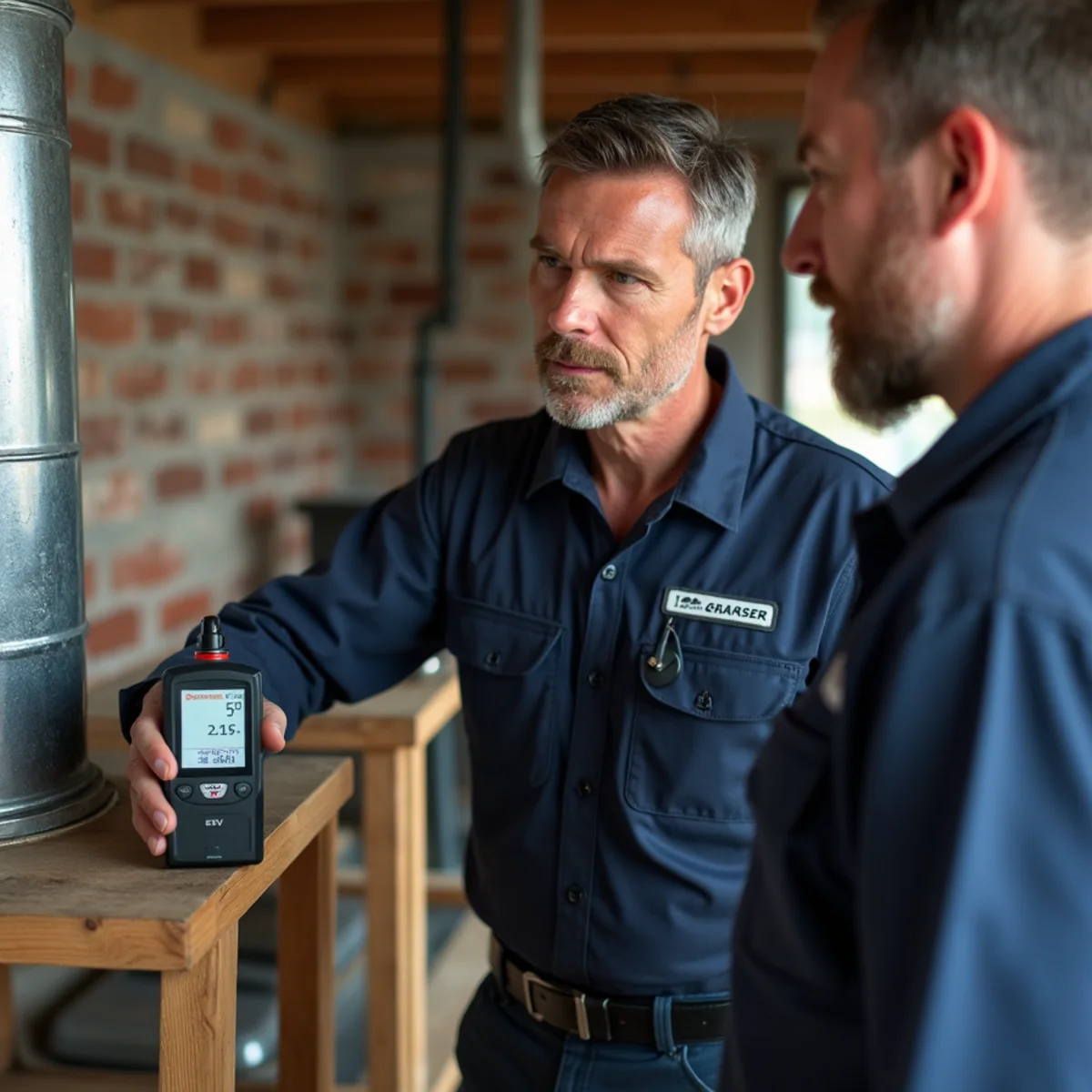
Here's a number every Franklin County homeowner should know: our county's average indoor radon reading runs around 7.8 pCi/L — nearly double the EPA's 4.0 action level, and high enough that radon professionals classify our zone as elevated-risk. Radon is the leading cause of lung cancer among non-smokers, it's odorless, and it's in the ground under a lot of Frankfort.
The good news: it's measurable, and it's fixable. Here's what our air-quality work does on the ventilation side, and where certified mitigation fits when levels run high.
What Radon Is and Why It's Here
Radon is a radioactive gas produced by the natural decay of uranium in soil and rock — and Bluegrass limestone and shale carry their share. It seeps upward and concentrates indoors wherever homes meet the ground: basements, crawlspaces, slab foundations. Franklin County's geology plus our housing stock (lots of basements and crawlspaces) produces the elevated averages.
The critical fact: averages don't predict houses. Neighboring homes can read wildly differently, which is why the only meaningful number is the one from a test kit in your own basement. Short-term kits are inexpensive and hardware-store available; we help interpret results on request.
What Ventilation Can — and Can't — Do
Mechanical ventilation reduces radon exposure by diluting and exhausting the gas: balanced ERV/HRV systems exchange indoor air for filtered outdoor air without dumping your heating and cooling, crawlspace encapsulation with conditioned ventilation stops the soil-gas pathway into living space, and positive-pressure strategies can push back against soil gas entry. For moderately elevated levels, these measures meaningfully reduce exposure.
For confirmed high readings — think 8+ pCi/L — the definitive fix is active soil depressurization: a certified mitigation system that sucks soil gas from beneath the slab and vents it above the roofline. That's specialized work we coordinate with certified mitigation specialists. Our role is the ventilation integration, crawlspace work, and the HVAC-side improvements that stack with mitigation.
Need this handled by a pro today?Same-day service across Franklin County • 24/7 emergency dispatch
Call +1 (327) 210-5999The Crawlspace Connection
In crawlspaced homes — common from Switzer to Bridgeport to the river neighborhoods — the crawlspace is radon's front door AND the moisture source behind that musty summer smell. Encapsulation (sealed ground vapor barrier, sealed vents, conditioned or dehumidified space) addresses both: it cuts the soil-gas pathway and ends the humidity that ages ductwork and equipment.
We've encapsulated enough Frankfort-area crawlspaces to say this plainly: it's one of the highest-return health investments a crawlspace home can make, radon aside. With our county's radon averages, it's not aside at all.
Filtration Is Not Radon Control (But It Matters)
Be clear-eyed: filters catch particles, not gases — a MERV-13 cabinet doesn't stop radon or its decay products' gas phase. What filtration does is catch the radioactive decay particles (radon daughters) that attach to dust, which is a real but secondary benefit. The primary levers remain testing, soil-gas control, and ventilation.
Where filtration earns its keep in every Franklin County home: Kentucky's pollen seasons, duct leakage pulling crawlspace dust, and the general particle load that our humidity-rich climate farms. The full air-quality picture stacks: test radon, control the source, ventilate deliberately, filter well.
Your Next Three Steps
One: test — a short-term kit this month; long-term kits give a better annual picture. Two: if results are elevated, get a professional mitigation quote (we'll coordinate) and talk with us about the ventilation and crawlspace work that complements it. Three: retest after mitigation to verify — then test every couple of years or after major renovations.
Call +1 (327) 210-5999 for an air-quality assessment. Radon is the serious item in Frankfort's air-quality conversation — and unlike most serious things, it's fixable with a phone call and a plan.
- Test: a short-term kit this month; long-term kits give the truer annual picture. Test the lowest lived-in level.
- If results are elevated: get a professional mitigation quote — we coordinate with certified specialists for active soil depressurization.
- Layer the HVAC-side work: crawlspace encapsulation, balanced ERV/HRV ventilation, and duct sealing that stops drawing soil-influenced air into living space.
The Bottom Line
Franklin County's radon average is nearly double the EPA action level, and the only number that matters is the one from your own basement. Test this month; if it's elevated, source control plus deliberate ventilation fixes it. Our air-quality assessments start that plan — and the test kit is the highest-leverage health purchase in county real estate.
Frequently Asked Questions
It's the county-level published average — your house could test higher or lower, and neighbors' results don't transfer. That's exactly why individual testing is the only meaningful answer.
Tight construction reduces dilution — it can concentrate whatever enters, radon included. Newer subdivisions like Bentwoods and Two Creeks are exactly where testing matters, despite the fresh construction.
Circulation alone mostly redistributes. Deliberate mechanical ventilation (ERV/HRV, balanced supply/exhaust) and source control are what actually reduce concentrations — that's the system we design when results are elevated.